
In memoriam · book of condolence
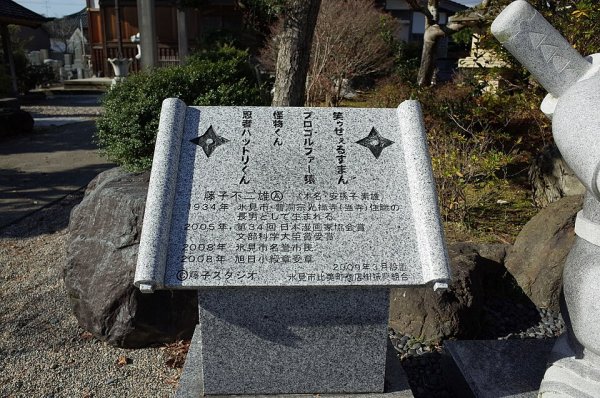
Motoo Abiko
also known as Motoo Abiko
- Born
- 10 March 1934
- Died
- 6 April 2022
- Age
- 88 years
- Resting place
- Japan Countries
Biography
Fujiko Fujio (藤子 不二雄) was a manga writing duo formed by Japanese manga artists Hiroshi Fujimoto (藤本 弘, Fujimoto Hiroshi; December 1, 1933 – September 23, 1996) and Motoo Abiko (安孫子 素雄, Abiko Motoo; March 10, 1934 – April 6, 2022). They debuted in 1951 as a duo under their real names. The Fujiko Fujio name was used for their respective works from 1953 until 1987, when Fujimoto became too ill to work consistently.
The pair was best known for their popular children's manga series, including Obake no Q-Tarō, Ninja Hattori-kun, Kaibutsu-kun, Perman, Kiteretsu Daihyakka and Doraemon. Some of their influences include Osamu Tezuka as well as international cartoons and comic books. Both artists base their writing style on a mix of morals with a subversive and wry sense of humor; their styles would evolve to the point of diversion, where Fujimoto focused on speculative science fiction in addition to children's works, while Abiko leaned towards the surreal and black comedy.
Their work received critical acclaim and, on Fujimoto's part, universal recognition, with Doraemon being officially recognized as a cultural icon of modern Japan.
Pen names
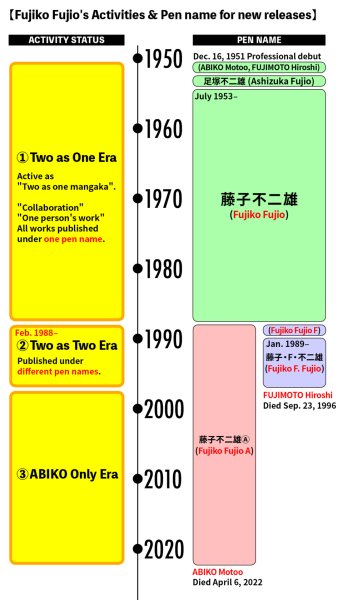
For many years after their debut, they collaborated and wrote individually under one pen name. However, after 1988, they published under separate names.
Fujiko Fujio
From July 1953 to around January 1988, the two published both collaborations and individual works under one pen name, Fujiko Fujio (藤子 不二雄).
Fujiko F. Fujio
Fujimoto used the pen name Fujiko F. Fujio, stylized as Fujiko・F・Fujio (藤子・F・不二雄), from 1989 until his death.
Fujiko A. Fujio
Abiko used the pen name Fujiko Fujio A, stylized as Fujiko Fujio Ⓐ (藤子不二雄Ⓐ), from 1988 until his death. His pen name is romanized as Fujiko A. Fujio in Western publications.
Biography
Hiroshi Fujimoto and Motoo Abiko were both from Toyama Prefecture. Fujimoto was born on December 1, 1933, and Abiko on March 10, 1934. Abiko transferred to Fujimoto's elementary school in Takaoka City and happened to see Fujimoto drawing in a notebook. The two became lifelong friends, and during the early years of their friendship kept their illustrations hidden from friends and classmates out of embarrassment.
In junior high school they were greatly influenced by Osamu Tezuka and his manga series Shin Takarajima. Fujimoto built a homemade episcope and together they wrote a piece for it called Tenküma, which was their first collaborative work. They started submitting work to periodicals such as Manga Shōnen and opened a joint savings account through Japan Post to which they both contributed funds and which they used to purchase art supplies. They divided all income and expenses equally between each other, a practice they continued throughout the life of their partnership.
In high school, they made their publishing debut, Tenshi no Tama-chan being adopted for serialization by Mainichi Shogakusei Shimbun in 1951. That same year they paid a visit to Tezuka's residence in Takarazuka, Hyōgo and showed him illustrations for their work titled Ben Hur. Tezuka complimented the two's abilities, some years later commenting that he knew then they were going to be major figures in the manga industry. Abiko and Fujimoto treasured the meeting with the respected Tezuka, and kept the Ben Hur illustrations for their entire lives. It was at this time they decided to make their partnership permanent. The two initially adopted the name Tezuka Fujio out of respect, but later changed it to Ashizuka Fujio as they perceived the use of the name "Tezuka" as too close to that of their idol.
Because both Fujimoto and Abiko were eldest sons respectively, they decided to take company jobs after graduating from high school in 1952. Fujimoto found employment with a confectionery company, and Abiko began working for the Toyama Newspaper Company. However, Fujimoto quit within a matter of days. Fujimoto then dedicated his time to submitting work to periodicals, with Abiko assisting him on the weekends. Their first serial as Ashizuka Fujio was terminated in a few episodes, followed by success with the post-apocalyptic science fiction series Utopia: The Last World War (UTOPIA—最後の世界大戦, UTOPIA: Saigo no Sekai Taisen).
At Fujimoto's urging, they elected to move to Tokyo in 1954 as professional manga artists, Abiko only reluctantly as he had steady employment at the Toyama Newspaper Company. Their first place of residence was a two-tatami mat room at the second floor of a watch shop. They eventually moved to the Tokiwa-sō apartment complex when Tezuka offered them a room that he was moving out of. Together with Hiroo Terada and several other manga artists of the period, they formed a collaborative group called "New Manga Party" (新漫画党, Shin Manga-To). At the apartment complex where the group was based, they enjoyed a period of productivity that had Fujimoto and Abiko carry up to six serials a month for publication. Additionally, Abiko contributed to Tezuka's works as an artist assistant, such as drawing a blizzard on the last page of Jungle Emperor.
The workload proved excessive, and in 1955 on return to Toyama for Japanese New Year the pair missed all the deadlines for their serials. The loss of credibility with publishers hurt Fujimoto and Abiko for a year. During the Tokiwa-sō era, they purchased a television set in Akihabara and made independent films with an 8mm camera. By 1959 they left Tokiwa-sō and moved to Kawasaki in Kanagawa Prefecture. In the 1960s, Fujimoto and Abiko founded Fujiko Studio Co., Ltd., a joint manga production company. Fujimoto got married on October 31, 1962, at the age of 28.
In 1963, Fujimoto and Abiko established Studio Zero with Shin'ichi Suzuki, Shotaro Ishimori, Jirō Tsunoda and Kiyoichi Tsunoda. Later Fujio Akatsuka joined, and at its peak the studio employed about 80 people. The studio produced several animated series and stood in for Mushi Production for an episode of Astro Boy. These were some of the duo's most productive years, resulting in series such as Obake no Q-Tarō which eventually were made into anime series on television. Abiko got married in 1966, at the age of 32. Fujimoto concentrated on titles for children, with a particular interest in science fiction.
In 1968, Abiko started making manga for a more mature audience, with titles such as Kuroi Salesman. In the 1970s, Abiko focused on both adult and boys' manga. The style was full of black humor. Fujimoto focused on both adult and childhood manga. His style was notable for its sense of wonder.
Doraemon was created in 1969. Since around 1974, its popularity has skyrocketed among Japanese children. CoroCoro Comic released its first issue in 1977 to showcase the works of Fujiko Fujio. With syndication of Doraemon on TV Asahi in 1979, a surge of popularity saw up to a dozen collaborative and solo works by Fujimoto and Abiko picked up for publication and syndication throughout the 1980s. Doraemon is the only work by the duo to ever get an official release in English-speaking countries, most notably the United States, though English dubs of work such as Perman and Ninja Hattori-kun have aired in Asia to less fanfare. Bones have produced an adaptation of Fujimoto's series Time Patrol Bon for Netflix, an unusual move due to the original series' obscurity.
In 1987, citing creative differences, Fujimoto and Abiko ended their long partnership to concentrate on solo projects. From now on, Abiko would work at Fujiko Studio K.K. and Fujimoto in Fujiko F. Fujio Pro K.K. Abiko adopted the pen name Fujiko A. Fujio, while Fujimoto adopted the pen name Fujiko F. Fujio.
According to Abiko, the cause for the dissolution of the partnership was due to Fujimoto discovering he had stomach cancer in 1986, and both Fujimoto and Abiko had a desire to settle copyright and financial issues before the other died.
Fujimoto died of liver failure at a hospital in Shinjuku on September 23, 1996.
A documentary was aired on TV Asahi on February 19, 2006, chronicling the life and times of Fujiko F. Fujio.
The Fujiko F. Fujio Museum opened in Kawasaki, Kanagawa on September 3, 2011, which features a reproduction of Fujio's studio and a display of their artwork.
Abiko died of natural causes at his home in Kawasaki on April 6, 2022.
Awards
1989, 1990, 1991, 1992, 1993, 1994, 1996, 1997, and more – Golden Gloss Prize (ゴールデングロス賞) (Movie Doraemon etc.)
2005 – Japan Cartoonists Association Award Minister of Education, Culture, Sports, Science and Technology Award (All works)
2014 – Tezuka Osamu Cultural Prize Special Award (Manga Michi and Ai... Shirisomeshi Koro ni...)
Source: Wikipedia, available under the licence CC BY-SA 4.0.
In Memoriam web link
Photos
Condolences and flowers 0
The book of condolence for Motoo Abiko: offer your condolences to the family below, lay a flower or light a candle.
- TroostplekOur sympathy to all who are left behind.