
In memoriam · condoleanceregister
Syed Muhammad Naquib al-Attas
ook bekend als Syed Muhammad Naquib al-Attas
- Geboren
- 5 september 1931
- Overleden
- 8 maart 2026
- Leeftijd
- 94 jaar
- Rustplaatsen
- Filosofen & denkers Bekende mensen, Schrijvers & dichters Bekende mensen, Wetenschappers & uitvinders Bekende mensen, Maleisië Landen
Biografie
Syed Muhammad al Naquib bin Ali al-Attas (Arabic: سيد محمد نقيب العطاس Sayyid Muḥammad Naqīb al-ʿAṭṭās; 5 September 1931 – 8 March 2026) was a Malaysian Muslim philosopher of Arab descent. He was considered one of the few contemporary scholars who was thoroughly rooted in the traditional Islamic sciences and studied theology, philosophy, metaphysics, history, and literature. He pioneered the concept of Islamisation of knowledge. Al-Attas's philosophy and methodology of education have one goal: Islamisation of the mind, body, and soul and its effects on the personal and collective life of Muslims as well as others, including the spiritual and physical non-human environment. He was the second Malaysian to be awarded the title of Royal Professor (Profesor Diraja) after the late Ungku Abdul Aziz.
Al-Attas was the author of 27 works on various aspects of Islamic thought and civilisation, particularly on Sufism, cosmology, metaphysics, philosophy and Malay language, and literature.
Early life and education
Syed Muhammad Naquib al-Attas was born in Bogor, Java, Dutch East Indies on 5 September 1931, into a family with a history of illustrious ancestors and saints. Al-Attas was born into a family of Hadrami Arab sayyid lineage that had long been established in the Malay world. Some sources state his genealogical tree can be traced over a thousand years through the Ba' Alawi sayyids of Hadramaut. He was the second of three sons; his elder brother, Syed Hussein Alatas later became an academician and politician. He was the cousin of the academic Ungku Abdul Aziz.
After World War II, in 1946 he returned to Johor to complete his secondary education. He was exposed to Malay literature, history, religion, and Western classics in English.
After al-Attas finished secondary school in 1951, he entered the Malay Regiment as a cadet officer. There he was selected to study at Eaton Hall, Chester, England and later at the Royal Military Academy, Sandhurst, UK (1952–1955). During this time he became interested in the metaphysics of the Sufis, especially the works of Jami. He travelled to Spain and North Africa where the Islamic heritage had a profound influence on him. Al-Attas felt the need to study and voluntarily resigned from the King's Commission to serve in the Royal Malay Regiment, to pursue studies at the University of Malaya in Singapore (1957–1959).
While an undergraduate at the University of Malaya, he wrote Rangkaian Ruba'iyat, a literary work, and Some Aspects of Sufism as Understood and Practised among the Malays. He was awarded the Canada Council Fellowship for three years of study at the Institute of Islamic Studies at McGill University in Montreal. He received an M.A. degree with distinction in Islamic philosophy in 1962, with his thesis Raniri and the Wujudiyyah of 17th Century Acheh. Al-Attas went on to the School of Oriental and African Studies, University of London where he worked with Professor A.J. Arberry of Cambridge and Martin Lings. His doctoral thesis (1962) was a two-volume work on the mysticism of Hamzah Fansuri.
In 1965, al-Attas returned to Malaysia and became Head of the Division of Literature in the Department of Malay Studies at the University of Malaya, Kuala Lumpur. He was Dean of the Faculty of Arts from 1968 until 1970, where he instituted more consultative reforms. Thereafter he moved to the new National University of Malaysia, as Head of the Department of Malay Language and Literature and then Dean of the Faculty of Arts. He advocated the use of Malay as the language of instruction in the university. He founded and directed the Institute of Malay Language, Literature, and Culture (IBKKM) at the National University of Malaysia in 1973.
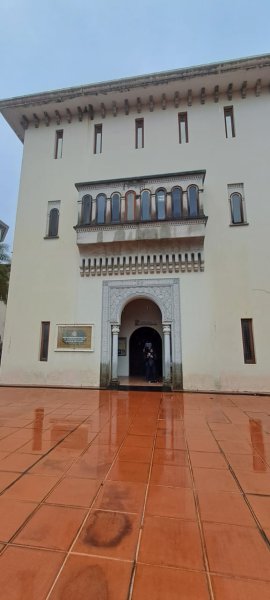
In 1987, with al-Attas as founder and director, the International Institute of Islamic Thought and Civilisation (ISTAC) was established in Kuala Lumpur. The institution was made to increase the consciousness of Islam to its students and faculty. Al-Attas incorporated Islamic artistic and architectural principles throughout the campus and grounds.
Malay literature and Sufism
Al-Attas authored Rangkaian Ruba'iyyat a literary work that was among the first ever published in 1959 and the classic work, Some Aspects of Sufism as Understood and Practised Among the Malays, in 1963. His two-volume doctoral thesis on The Mysticism of Hamzah Fansuri, which is the most important and comprehensive work to date on one of the greatest and perhaps the most controversial Sufi scholars in the Malay world earned him a PhD in the UK in 1965.
He engaged in polemics on the subjects of Islamic history, philology, Malay literary history and Sha'ir. He established that Hamzah Fansuri was the originator of the Malay Sha'ir. He has also set forth his ideas on the categorisation of Malay literature and the periodisation of its literary history. He contributed to the history and origin of the modern Malay language.
His commentaries on the ideas of Fansuri and al-Raniri are the first definitive ones on early Malay Sufis based on 16th- and 17th-century manuscripts. He discovered and published his meticulous research on the oldest extant Malay manuscript, wherein among other important matters, he also solved the issue of arrangements of the Malay-Islamic cyclical calendar. He was also responsible for the formulation and conceptualisation of the role of the Malay language in nation-building during debates with political leaders in 1968. This formulation and conceptualisation was one of the important factors that led to the consolidation of Malay as the national language of Malaysia. As the Dean of the Faculty of Arts, at the University of Malaya, he implemented a more systematic implementation of Malay as an intellectual and academic language in the university.
Islam and metaphysics
Al-Attas maintained that modern science sees things as mere things and that it has reduced the study of the phenomenal world to an end in itself. Certainly, this has brought material benefits; however, it is accompanied by an uncontrollable and insatiable propensity to destroy nature itself. Al-Attas maintained a firm critique that studying and using nature without a higher spiritual end has brought mankind to the state of thinking that men are gods or co-partners. "Devoid of real purpose, the pursuit of knowledge becomes a deviation from the truth, which necessarily puts into question the validity of such knowledge." [Islam and Secularism, p. 36]
Al-Attas viewed Western civilisation as constantly changing and 'becoming' without ever achieving 'being'. He analysed that many institutions and nations are influenced by this spirit of the West and they continually revise and change their basic developmental goals and educational objectives to follow the trends from the West. He pointed to Islamic metaphysics which shows that Reality is composed of both permanence and change; the underlying permanent aspects of the external world are perpetually changing [Islam and Secularism, p. 82]
For al-Attas, Islamic metaphysics was a unified system that discloses the ultimate nature of Reality in positive terms, integrating reason and experience with other higher orders in the suprarational and trans-empirical levels of human consciousness. He saw this from the perspective of philosophical Sufism. Al-Attas also said that the Essentialist and the Existentialist schools of the Islamic tradition address the nature of reality. The former is represented by philosophers and theologians, and the latter by Sufis. The Essentialists cling to the principle of mahiyyah (quiddity), whereas the Existentialists are rooted in wujud (the fundamental reality of existence) which is direct intuitive experience, not merely based on rational analysis or discursive reasoning. This has undoubtedly led philosophical and scientific speculations to be preoccupied with things and their essences at the expense of existence itself, thereby making the study of nature an end in itself. Al-Attas maintained that in the extra-mental reality, it is wujud (Existence) that is the real "essences" of things and that what is conceptually posited as mahiyyah ("essences" or "quiddities") are in reality accidents of existence.
The process of creation or bringing into existence and annihilation or returning to non-existence, and recreation of similars is a dynamic existential movement. There is a principle of unity and a principle of diversity in creation. "The multiplicity of existents that results is not in the one reality of existence, but in the manifold aspects of the recipients of existence in the various degrees, each according to its strength or weakness, perfection or imperfection, and priority or posteriority. Thus the multiplicity of existents does not impair the unity of existence, for each existent is a mode of existence and does not have a separate ontological status". He clarified that the Essence of God is transcendent and is unknown and unknowable, except to Himself, whereas the essence or reality of a thing consists of a mode of existence providing the permanent aspect of the thing, and its quiddity, endowing it with its changing qualities.
Death
Al-Attas died on 8 March 2026, at the age of 94. Funeral prayers for Al-Attas were held at Al-Taqwa Mosque in TTDI the following morning, with his burial taking place at the Bukit Kiara Muslim Cemetery.
Awards and achievements
Al-Attas developed a style and precise vocabulary that uniquely characterised his Malay writings and language. He also studied Islamic and Malay civilisations. In 1975, he was conferred Fellow of the Imperial Iranian Academy of Philosophy for his contribution in the field of comparative philosophy. He was also a speaker and an active participant at the First World Conference on Islamic Education held at Mecca in 1977, where he chaired the Committee on Aims and Definitions of Islamic Education. From 1976 to 1977, he was a visiting professor of Islam at Temple University, Philadelphia, United States. In 1978, he chaired the UNESCO meeting of experts on Islamic history held at Aleppo, Syria.
He was the first holder of the Chair of Malay Language and Literature at the National University of Malaysia (1970–84), and the first holder of the Tun Abdul Razak Chair of Southeast Asian Studies at Ohio University (1980–82) and as the Founder-Director of the International Institute of Islamic Thought and Civilisation (ISTAC) at the International Islamic University Malaysia (since 1987). He delivered more than 400 lectures throughout Europe, the United States, Japan, the Far East and the Muslim world. Anwar Ibrahim in 1993, appointed him as the first holder of the Abu Hamid al-Ghazali Chair of Islamic Thought at ISTAC. King Hussein of Jordan made him a Member of the Royal Academy of Jordan in 1994, and in June 1995 the University of Khartoum conferred upon him the Degree of Honorary Doctorate of Arts (D.Litt.).
He was also a calligrapher. His work was exhibited at the Tropenmuseum in Amsterdam in 1954. He planned and designed the: ISTAC building; the unique scroll of the al-Ghazali Chair (1993); the auditorium and mosque of ISTAC (1994); as well as their landscaping and interior decor.
Ancestry
Syed Naquib was of mixed ancestry; His father, Syed Ali al-Attas, was the son of a Hadhrami Arab preacher and a Circassian noblewoman. On his mother's side, Syed Naquib was the son of a Hadhrami Arab and a Sundanese noblewoman.
Bron: Wikipedia, beschikbaar onder de licentie CC BY-SA 4.0.
In Memoriam weblink
Foto's

Medeleven en bloemen 0
Het condoleanceregister van Syed Muhammad Naquib al-Attas: betuig hieronder uw medeleven aan de nabestaanden, leg een bloem of steek een kaars aan.
- TroostplekSterkte aan alle nabestaanden.